
Personal project
ForestServer
A solar-powered computer that lives in a tree, recording its surroundings according to the energy available.
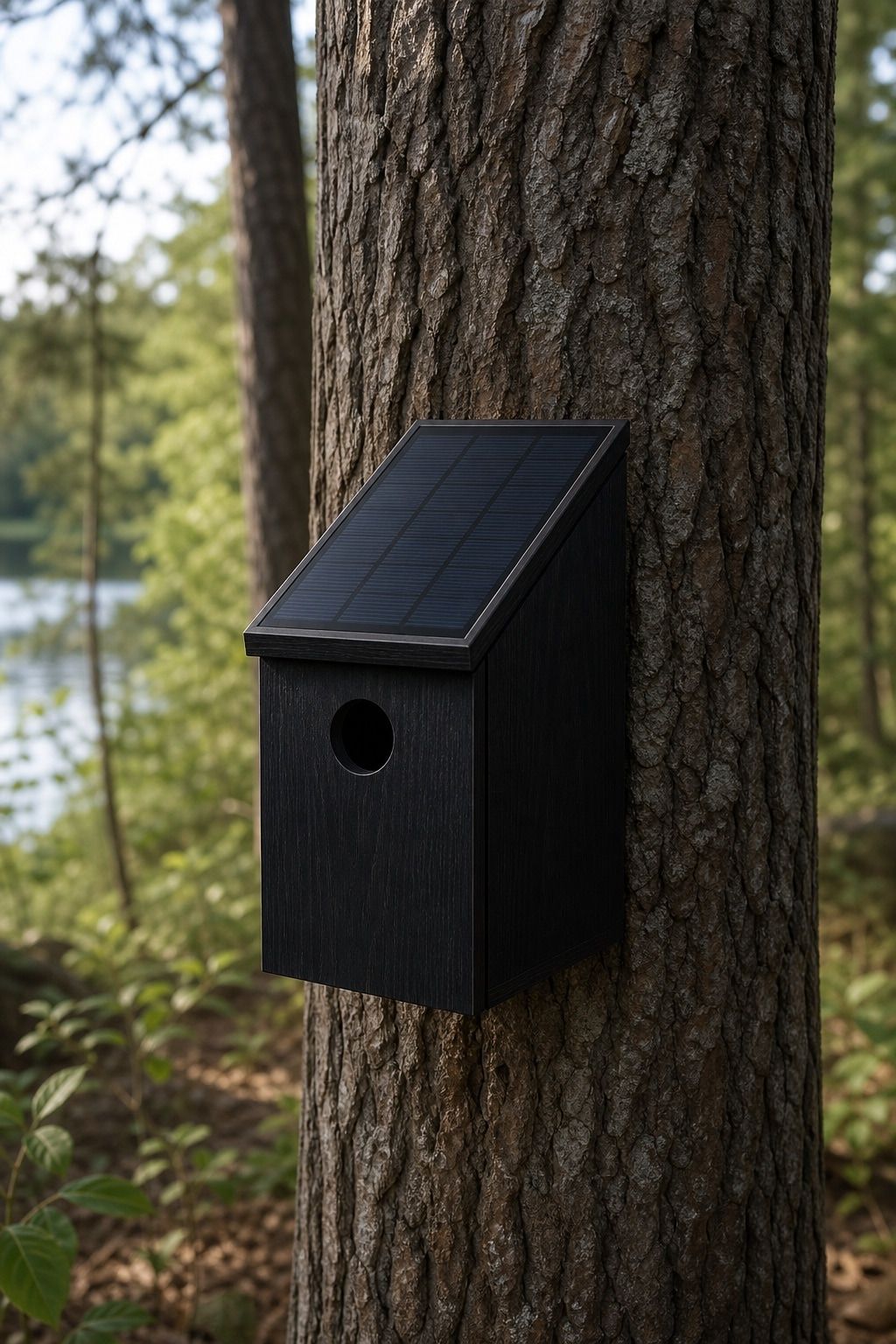
ForestServer is a networked artwork and environmental monitoring system. Its first node, DREY-0001, wakes periodically, reads the surrounding air, photographs and records the woodland, then transmits what it finds before returning to sleep.
How long it sleeps depends on how much sunlight it has gathered. In winter or heavy cloud, it rests longer.
An environmental web server
The project began with a question: what would a web server look like if it had to live within the limits of its environment?
DREY-0001 has a public address, but cannot promise constant availability. Its solar supply, battery, cellular connection and sleep cycles determine when it can observe and communicate.
Those constraints became the subject of the work. The infrastructure normally used to make the internet appear permanent instead preserves the machine’s presence while it sleeps. The page is served by the device, or by a memory of it.
The object
DREY-0001 resembles a minimal birdhouse made from charred birch plywood. Its solar panel forms the roof, while a circular aperture conceals the camera and environmental sensors.
The aperture responds to the installation site. Engraved text occupies another face, and the two never share a side. This rule gives every Drey a consistent identity while allowing each object to adapt to its tree, view and orientation.
Designing for intermittent power
An ESP32-CAM, environmental sensors and LTE modem run from solar-charged LiFePO4 cells. The device wakes, reads its sensors, captures media when conditions permit, stores results locally, transmits a batch and returns to sleep.
It records temperature, humidity, air pressure, air quality, light and sound. Images and audio become less frequent when power is scarce.
The website exposes rather than disguises this behaviour. Every observation carries an honest timestamp, and the interface distinguishes current, cached and hibernating states. An old winter image is not an error, but evidence of the conditions in which the system exists.
Edge architecture
The physical object remains a deliberately limited sensor node. Processing, storage and presentation happen at the Cloudflare edge.
A Worker receives authenticated transmissions and stores readings in D1, while KV maintains the latest device state. The site presents recent observations, battery trends and the expected sleep schedule.
This keeps firmware and power use modest while allowing the public experience to evolve independently of the installed hardware.
Machine and human observations
ForestServer also includes a public maintenance log. Sensors describe the site numerically; the keeper records what the machine cannot, including the condition of the tree, changes in the woodland and how the site felt.
Together, these observations build a portrait of one place over time.
A network of Dreys
DREY-0001 is the first in a proposed network. Future numbered nodes will contribute observations from other locations.
Firmware and construction knowledge will be open source, while inclusion in the public network remains curated: open as a method, considered as a collection.