
Delicious
Delicious
A self-hosted link memory for saving something in a second and finding it years later.
Browser bookmarks become unsearchable piles. Read-later apps are designed for the near future. Neither works particularly well for useful and interesting things I may want again several years later.
Delicious is a single-user, self-hosted link memory. It revives the best ideas from the original del.icio.us, particularly fast capture, flat tags and tag intersections, while removing the social layer and adding carefully constrained AI assistance. It is not an archive or another inbox to maintain. Its job is simply to remember.
Capture without consequences
A bookmarklet on desktop and an iOS Shortcut on mobile open a compact save page. The URL is persisted as soon as the page loads, before any further interaction.
The system fetches the title, description and page text, then drafts tags using the owner’s existing vocabulary. Tags and notes can be edited, but closing the tab loses nothing. At worst, the link has been saved with machine-generated metadata.
Re-saving a URL opens its existing record and shows when it was first saved. Links intended for immediate reading can also be sent to Readwise Reader, with their tags attached, from the same flow.
Retrieval starts with search
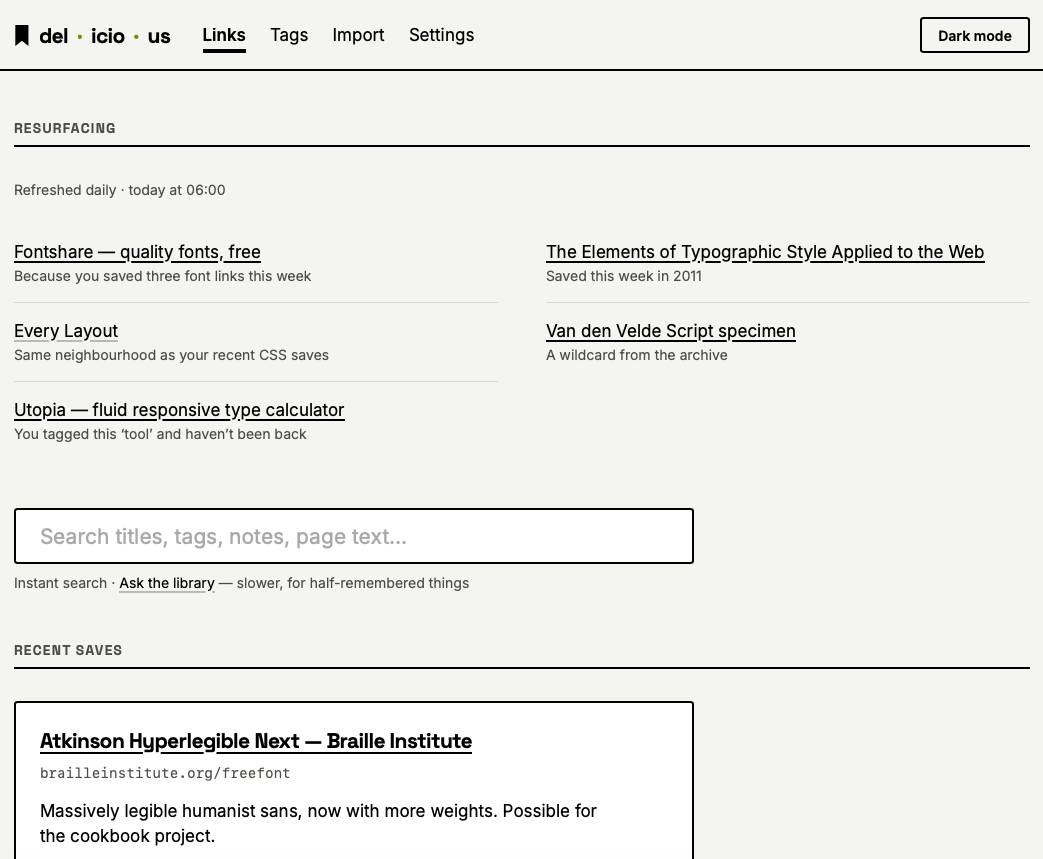
The main interface is a single search box. Results filter instantly across titles, tags, notes and text extracted when the page was saved. Title and tag matches rank above body-text matches, keeping broad page content useful without allowing it to swamp deliberate metadata.
Tags remain flat and composable. Selecting several creates an intersection with its own addressable URL, preserving one of the original Delicious’s simplest and most useful behaviours. There are no folders, collections, favourites or read states to maintain.
AI as a fallback
When literal search fails, an optional semantic mode handles half-remembered queries such as “that brutalist Dutch type foundry.”
After a successful result, selecting “This was it” suggests tags derived from the language used in the failed query. Accepting them adds that retrieval vocabulary to the record. Each AI rescue therefore improves ordinary search, making the semantic layer less necessary over time rather than more.
Designing for long memories
The import workflow handles browser and legacy Delicious exports, folders of .webloc files, pasted URLs and Readwise Reader records. Imports pass through a permanent bulk-editing workspace before AI tagging, allowing the machine vocabulary to form around the owner’s language.
Dead links are retained because their titles, notes and tags may still carry memory value, with the Wayback Machine available when the original page has disappeared.
A daily resurfacing module brings back a handful of links using recent interests, anniversaries and occasional wildcards. Each suggestion explains why it appeared, making rediscovery feel intentional rather than algorithmically mysterious.
Visual direction
The interface uses a soft-brutalist system: oversized Space Grotesk headings, thick black rules, warm concrete backgrounds and chartreuse reserved for focus and selection.
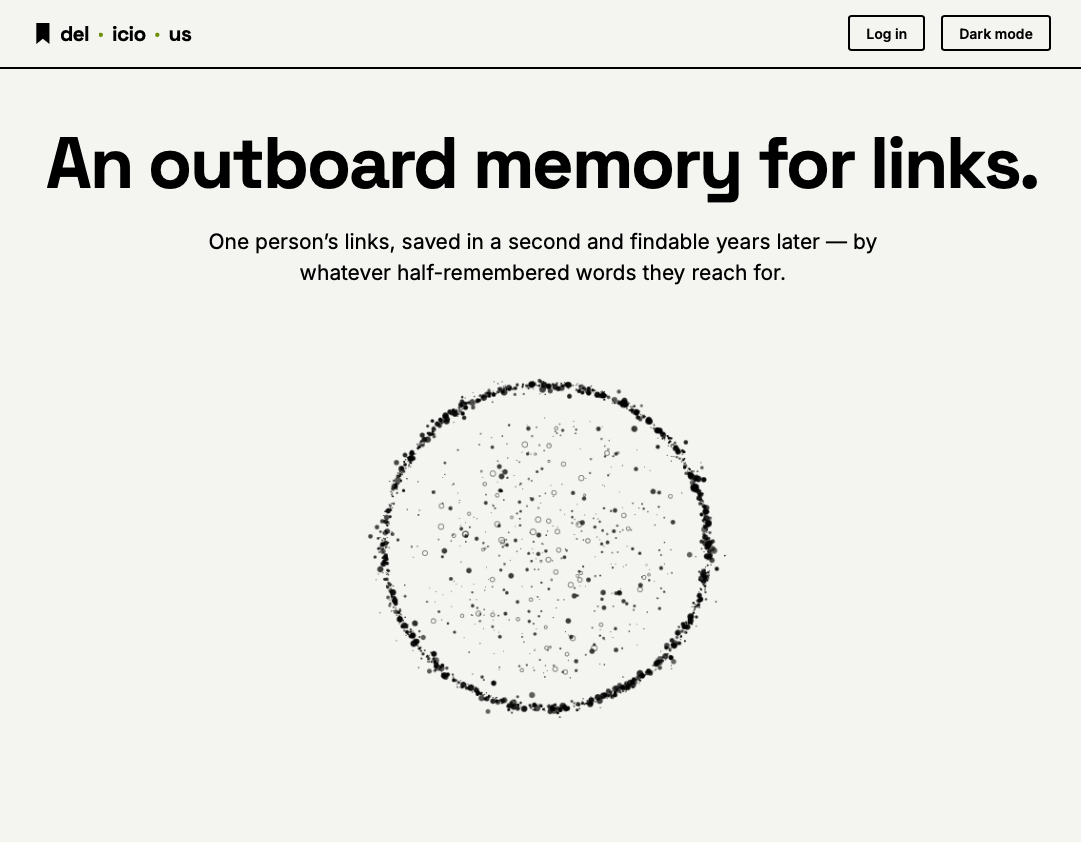
The treatment gives a personal utility a distinct identity without competing with its content. Dense records remain readable, controls remain obvious and search receives the greatest visual weight. The public-facing page exposes only aggregate shapes such as collection growth and saving rhythm; titles, tags and URLs remain private.
Technical direction
The proposed implementation uses Astro for server-rendered pages and API endpoints, with Svelte 5 islands for stateful interfaces such as tag editing and bulk import review.
SQLite keeps the application portable and self-contained. FTS5 provides weighted full-text search, with vector retrieval planned as a separate enhancement. Bookmarklets, Shortcuts and future integrations use the same API, while restricted save-only tokens remain separate from full-access credentials.
Export is a day-one feature in browser-compatible bookmark HTML and complete JSON. A personal memory should never depend on the continued existence of the software holding it.
Outcome
Delicious is an in-progress build, shaped through daily use as the library grows. A substantial product plan and phased roadmap provide the foundation, while real saving and retrieval habits continue to inform how the system evolves.
The result is deliberately small and clearly bounded: it does not try to organise the web. It remembers the parts I may need again.